
Skilled Nursing Center Receives Critical Backup Power Source
Tiburon Hills Care Center needed a permanent power back-up source.
The Challenge: If the power goes out, lives are at risk
Perched on a prominent Tiburon, California hillside with panoramic views of the San Francisco Bay and Golden Gate Bridge, this 1950s-era skilled nursing facility looks like serenity itself. But inside, a quiet danger loomed. The building had no permanent backup power. During wildfire season, when PG&E began rolling blackouts to prevent fires, the risk was real. Residents of the facility rely on life-supporting systems that need power to operate.
A temporary generator had been parked in the lot for years. But it was a stopgap measure—and an expensive one. “It’s been paid for three times already since COVID. They’ve been paying monthly rent to have it there,” Joe explained.
The Building: A Midcentury Marvel with Outdated Infrastructure
Architecturally, the building was a standout. “It’s kind of post-Frank Lloyd Wright,” Joe said. “California modern, almost like an Eichler with big open ceilings. A triangle footprint.” That was cutting-edge architecture in the 1950’s. But the building didn’t age well when it comes to HVAC or energy resilience. “The 1950s technology and building just haven’t weathered the climate, and the technology has left it behind.”
Originally built as a family-owned care center, it had gradually become encircled by luxury homes. Its long, private driveway was deeded to the city years ago and turned into a public street.
The Owner’s Goal: Upgrade Safety and Meet State Regulations
Ownership changed hands. What was once a family-operated facility is now in the portfolio of Provident Health—a large healthcare corporation that invests in skilled nursing facilities.
The construction was under the authority of the state, OSHPD, now HCAI, which handles hospitals and skilled care. Also there was oversight by the Bay Area Air Quality Management District. Everything has to meet hospital-level scrutiny. “They have very strict reviews and regulations, and they would not allow the center to keep that portable charging station. That is why they are putting in a permanent backup power system.” The Meylan team had to navigate multiple regulatory layers. “You’re not just working with city building inspectors,” Joe said. “
The corporation’s goal was clear: remove the costly power supply rental, install a compliant permanent system, and ensure they could safely operate under any conditions.
The Meylan Solution: A Fortress Carved Into a Hill
Joe’s team didn’t just install a generator. They engineered a hillside power bunker. “We had to drill holes into the hill, big concrete piles.” Joe said.
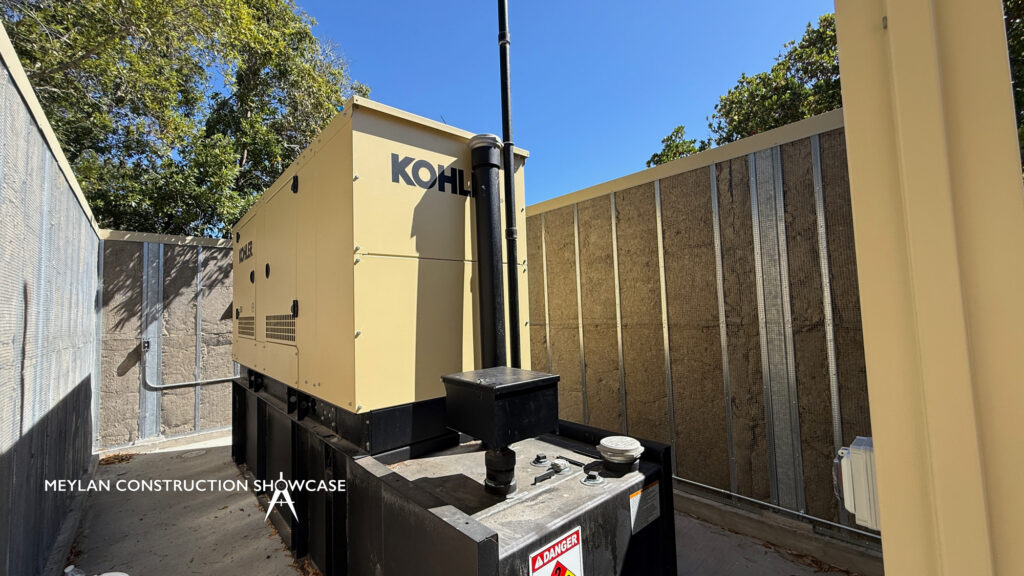
It’s a dual-fuel system: natural gas for standard outages, diesel for full-scale failures. “It’s backup to the backup,” Joe said. “If PG&E cuts electricity but the gas stays on, the generator runs on gas. If both go out, it switches to diesel. Generators are moving along with technology. They are on a timer where they automatically start up every so often. They self-fire up to test. They really have gotten a lot more automated now. They send out notices automatically if the test results need review.”
A specially designed acoustic fence surrounds the structure to reduce noise impact on neighbors when the generator is activated. And the generator will be continuously monitored for emissions, performance, and sound. Landscaping has been added to help blend the structure into the hillside and now it is barely noticeable.
Unique Challenges: Power, Politics, and Paperwork
One of the trickiest hurdles was jurisdiction. The city of Tiburon wasn’t thrilled about being sidelined. “They wanted to have a say over what happens in their jurisdiction,” Joe said. But the state oversees the facility for licensing.”
The Bay Area Air Quality Management Board District added another layer of complexity in addition to OSH. We will have to pass tests such as a pressure test of the tank, and emissions testing.
The Outcome: Safety, Compliance, and Peace of Mind
The project is nearly complete. The generator is in place. Final tests are underway. And soon, the facility will be running on a system built for resilience, not patchwork fixes.
Once the new generator is approved, the facility will be able to have the rental generator removed from the parking lot.
Most importantly, it means safety. Families can rest easier knowing their loved ones are protected, no matter what the grid does.